- Sy.No.819/Part, Kistapur Road, Medchal, Hyderabad.
- 9440247110
info@techmechcranes.com

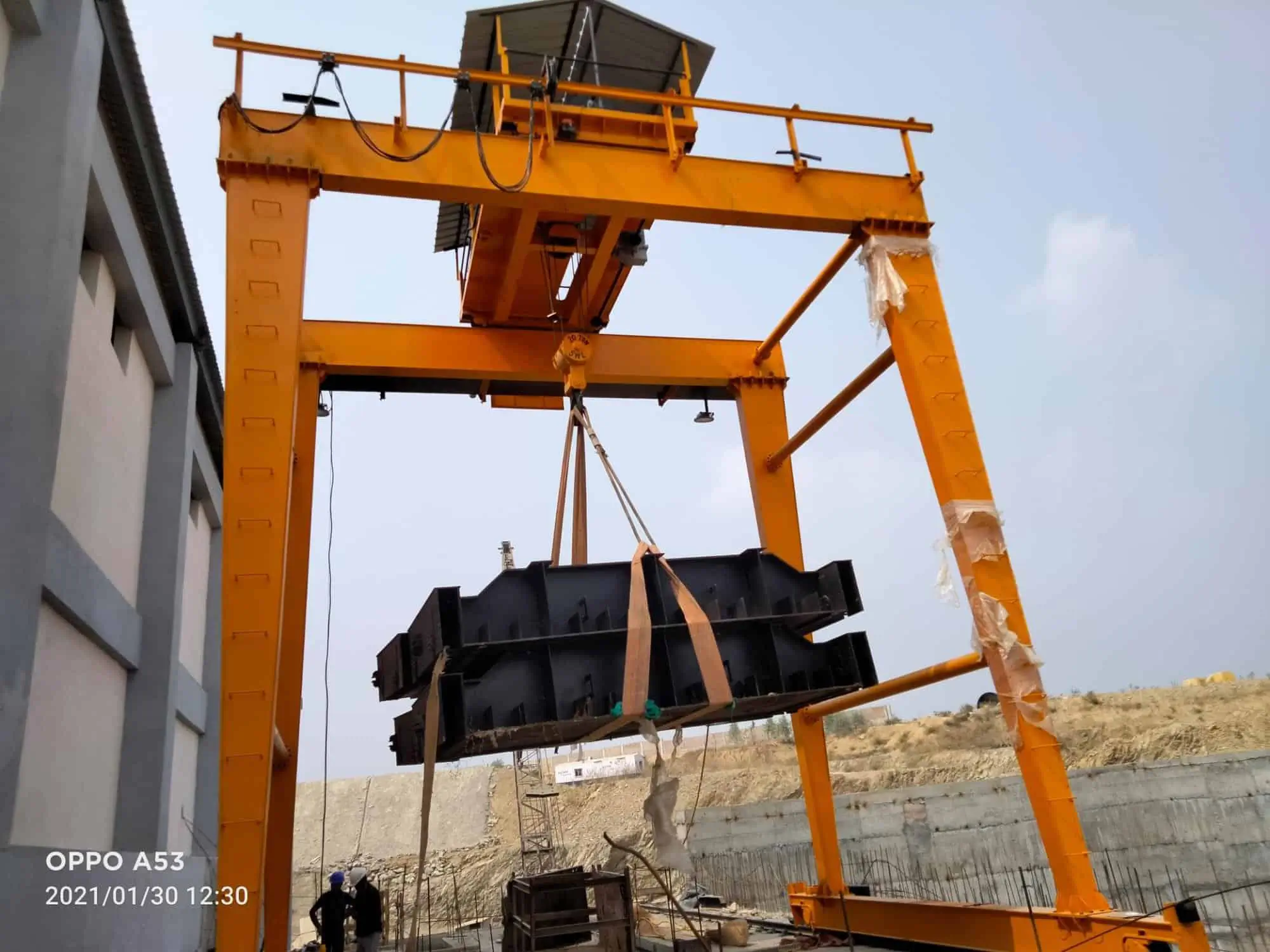
TechMech Cranes is among the Gantry Crane Manufacturers offering gantry crane systems for industrial material handling applications where the controlled lifting and movement of heavy or bulky loads is required. The company develops crane systems based on application requirements such as load capacity, span, lifting height, travel distance, duty cycle, operating environment and load characteristics.
Gantry cranes are particularly useful when a conventional overhead runway is impractical or when lifting needs extend over open working areas. The free-standing structural design offers a dedicated lifting and traveling system for manufacturing, fabrication, storage yards, construction, infrastructure and other material handling applications. TechMech Cranes design the crane systems based on the customer’s specification and application conditions.
TechMech’s gantry crane manufacturing process includes structural engineering, mechanical assembly, hoisting systems, travel mechanisms, electrical controls, inspection and commissioning. Each system can be adapted to suit the working conditions rather than having to be based on a single standard arrangement.
Gantry Crane Design begins with understanding the lifting application, load characteristics, available working area, span required, lifting height, travel path, frequency of operation and environmental conditions. These factors influence the structural arrangement, hoisting equipment, traveling mechanism, controls and safety provisions.
The supporting structure consists of main girder, legs, end carriages, wheels, rail or travel arrangement and other related structural members. The fabrication and assembly must be dimensionally accurate and properly aligned to facilitate smooth travel of the crane and load handling.
A gantry crane combines hoisting, cross-travel and long-travel functions into one material handling system. Depending on the application the configuration may comprise an electric hoist or trolley, travel drives, electrical panels, pendant or control systems, limit switches and other safety devices.
Different working environments require different arrangements of the cranes. TechMech has a broad product portfolio of double girder gantry/goliath cranes and semi-gantry cranes, but gantry systems can also be built around single- or double-girder requirements.
This is a configuration with one main bridge girder and the hoisting mechanism that travels along the girder. Where the necessary lifting capacity, span and operating conditions are compatible with a single girder arrangement, it may be regarded as suitable.
These cranes consist of two main girders and are used in applications that require higher structural capacity, increased lifting or specific trolley arrangements. TechMech manufactures Double Girder Gantry / Goliath Cranes for Heavy Duty Material Handling Applications.
A semi gantry crane is a combination of a gantry configuration and an overhead support structure. It can be useful where only part of the working area needs crane travel supported by ground. TechMech’s semi-gantry systems are designed as per required load capacity and size.
Goliath cranes are a type of gantry or portal crane built on vertical legs, and designed to travel along a suitable ground level rail or wheel system. They can be installed for various spans, lifting heights, speeds and operating duties.
A Customized Gantry Crane is designed specifically for the actual lifting application, not just selected by nominal capacity. TechMech Cranes reviews operating requirements before finalizing the crane configuration.
| Design Parameter | Consideration |
|---|---|
| Load Capacity | Maximum working load and load characteristics |
| Span | Required distance between supporting legs or travel paths |
| Lift Height | Required vertical lifting range |
| Travel Distance | Required longitudinal movement |
| Hoisting Speed | Required lifting and lowering speed |
| Travel Speed | Required cross and long travel speeds |
| Duty Cycle | Frequency and intensity of crane operation |
| Working Environment | Indoor, outdoor, temperature, dust, moisture and other conditions |
| Load Characteristics | Dimensions, centre of gravity and handling requirements |
| Control System | Pendant, cabin, remote or other suitable controls |
| Power Supply | Electrical supply and crane power arrangement |
| Site Conditions | Rails, floor conditions, clearances and installation constraints |
With this application driven approach the Gantry Crane Manufacturer has the possibility to determine a proper structural and mechanical configuration taking into account the whole operating environment.
Industrial Gantry Cranes are used to lift and transport heavy or bulky materials over a particular working area.
Typical applications are:
The choice of a gantry crane depends on the weight of the load, the movement pattern, the available space, the required lifting height, the travel distance and the operating frequency.
Gantry cranes can be configured for a variety of industrial environments where typical overhead crane configurations may not provide the required coverage or installation flexibility.
Applications may be:
TechMech’s present gantry portfolio includes systems for applications in construction, shipbuilding, shipping yards, scrap yards, tunnels, dams and irrigation projects.
A structured Gantry Crane Manufacturing process helps to guarantee the finished crane meets the specified operating requirements.
The first step is to identify required load capacity, span, lift, travel distance, duty cycle, operating environment, load characteristics and available installation space.
The engineering phase will translate the application requirements into an appropriate crane layout. In this stage, the design, dimension, control, and other safety features are considered.
The crane structure is constructed to the approved engineering requirements. Preparation of main girders, legs, end carriages and supports and related structural members for assembly.
As per the crane configuration mechanical parts such as hoists, trolleys, wheels, gear boxes, brakes, couplings and travel mechanisms are assembled.
Various parts such as the control systems, limit switches, power hookups, and other related devices are integrated to ensure they work properly.
Before the crane is put into service, inspection is made of fabrication, dimensions, assembly, mechanical movement, electrical connections, controls and safety functions.
Once the crane is assembled, it is installed and assembled at the required site and made sure the whole setup meets the required specifications.
A gantry crane is a combination of structural, mechanical, electrical and control components. Common components include:
The selection of the final components is dictated by the capacity, configuration, duty, travel requirements, and operating environment of the crane.
Choosing a Gantry Crane Manufacturer is more than just comparing lifting capacity. The complete operating specification should be considered before manufacturing begins.
The most important parameters are:
For example, TechMech’s published information on its gantry and semi-gantry products shows that crane capacity, span, lift, standards and configuration vary according to the particular type of crane.
Testing is an integral part of Gantry Crane Manufacturing. The crane has to perform its lifting, traveling and control functions as per the specified requirements. Typical checks can include:
TechMech’s current gantry information mentions the standards like IS 3177, IS 4137 and IS 807 for its double-girder gantry/goliath systems while its semi-gantry information mentions IS 3177, IS 807 and IS 800. The relevant requirements should be confirmed against the specific design of the crane and the project specification.
Buyers should assess the manufacturer’s ability to understand the application and translate that into a suitable crane design when evaluating Gantry Crane Manufacturers. Key points for evaluation:
The correct manufacturer should be able to talk through the full lifting requirement rather than choose the crane based on nominal load capacity alone.
TechMech Cranes has the engineering and material handling experience in the development of gantry crane systems. The company was founded in 2011 by engineers and associates and has grown its portfolio of material handling equipment to include gantry/goliath cranes, EOT cranes, jib cranes, electric hoists, electric winches and other lifting equipment.
TechMech’s approach for gantry crane requirements is:
Crane systems are also custom-designed to customer specifications so assessment of requirements is an important part of the engineering process, the company says.
The following information is helpful for developing an appropriate crane configuration and quotation:
Giving these details enables the manufacturer to evaluate the application and design a more suitable Customized Gantry Crane setup.
A gantry crane is a lifting system with supporting legs that travel along ground-level rails or a suitable running surface. It helps lift and move heavy loads from one location to another within a work area.
Gantry cranes are used to lift and move heavy materials in factories, fabrication units, shipyards, construction sites and storage yards. They help in the safe and efficient handling of steel components, machinery and other bulky loads.
There are many types of gantry crane configurations including single girder, double girder, semi-gantry and goliath cranes. Each type is good for different lifting conditions and workspace layouts. Which is the right model depends on load capacity, span, lifting height, available space and the nature of the work.
A single girder gantry crane uses one main beam to support the hoist, whereas a double girder crane has two main beams. The choice between them depends on the weight of the materials being lifted, the required span, lifting height, and the demands of the job.
Yes. A gantry crane can be built to suit the work it needs to handle. Its dimensions, lifting capacity, travel range, operating speed, controls, and other features can be selected according to the site's requirements.
The first things to consider are the load weight, its size, and the distance it needs to travel. The available headroom, span, lifting height, frequency of use, site layout, power supply, and operating conditions also affect the final specifications.
To choose the right gantry crane, the manufacturer needs to know the load weight, required span and lifting height, and how far the crane must travel. Details about the load, working conditions, frequency of use, operating speed, controls, power supply, and available space also help determine the right design.
A gantry crane is supported by legs and generally runs on rails or a travel path at ground level. An EOT crane moves along elevated runways, usually installed within a factory or industrial building. The main difference is how each crane is supported and moves around the work area.
Before a gantry crane is put to work, its structure, moving parts, hoist, brakes, electrical connections, and controls need to be checked. The crane's lifting and travelling functions are also tested, along with its safety devices. Load tests are performed where required under the applicable standards and project specifications.
TechMech Cranes looks at the type of material to be lifted, its weight, the required lifting height, and the distance the crane must cover. The available working space, frequency of operation, site conditions, and required controls also help determine a suitable design.
TechMech Cranes have a strong tradition of being designed and built to provide reliable material handling solutions for our valued domestic and international customers.